Jingdezhen Baluste Vase (Part 2)

Jingdezhen Baluste Vase (Part 2)

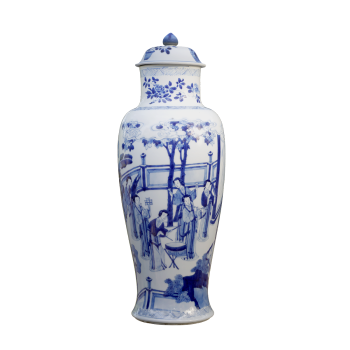
It is one of the five piece decoration set, characterized by the use of cobalt pigment under transparent colorless glaze. Belonging to Jingdezhen style, it is a ceramic container produced in Jingdezhen City, Jiangxi Province, China. The production period was from 1662 to 1722, belonging to the Qing Dynasty. Not only is it a representative of Chinese ceramic craftsmanship, but it also showcases the exquisite craftsmanship and aesthetic style of Jingdezhen porcelain during the Qing Dynasty. Jingdezhen, as the hometown of Chinese porcelain, has been renowned for its exquisite porcelain since ancient times. During the Qing Dynasty, the porcelain craftsmanship of Jingdezhen reached a new height, producing many porcelain pieces with high artistic and historical value.
Jingdezhen Ballust Vase

Jingdezhen Ballust Vase

It is one of the five piece decoration set, characterized by the use of cobalt pigment under transparent colorless glaze. Belonging to Jingdezhen style, it is a ceramic container produced in Jingdezhen City, Jiangxi Province, China. The production period was from 1662 to 1722, belonging to the Qing Dynasty. Not only is it a representative of Chinese ceramic craftsmanship, but it also showcases the exquisite craftsmanship and aesthetic style of Jingdezhen porcelain during the Qing Dynasty. Jingdezhen, as the hometown of Chinese porcelain, has been renowned for its exquisite porcelain since ancient times. During the Qing Dynasty, the porcelain craftsmanship of Jingdezhen reached a new height, producing many porcelain pieces with high artistic and historical value.
Exquisite lotus ceramic made by Zhou Haiqing
Exquisite lotus ceramic made by Zhou Haiqing

Zhou Haiqing is a ceramic artist from Hebei Province, specializing in the technique of making clear mud pottery, which has been listed as a municipal intangible cultural heritage. He not only inherited the traditional tire making techniques of his ancestors, but also had the courage to innovate, forming his own unique artistic style. There is a wide variety of works, including clay pots, pottery bottles, pen holders, etc., and I am particularly skilled in making clear mud cricket jars. The work is known for its rustic and natural style, smooth lines, and jade luster, and has received widespread praise from peers and collectors. This work embodies the beauty of lotus flowers, with a hollow design on the top flower ball and three small rabbits on the base. Highlighting Zhou Haiqing's superb skills.
Japanese Red crowned Crane Black Ceramic Bottle (Right) - Krakow Japan Art and Technology Center, Poland
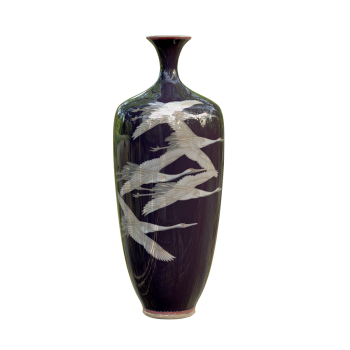
Japanese Red crowned Crane Black Ceramic Bottle (Right) - Krakow Japan Art and Technology Center, Poland

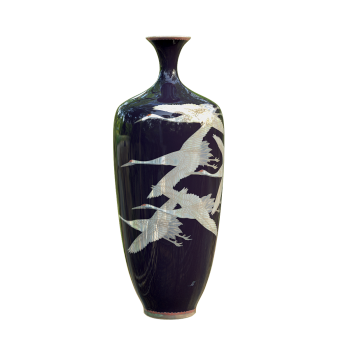
The Japanese Art and Technology Center, located in Krakow, Poland, is renowned for its exquisite craftsmanship and traditional themes, showcasing the level of Japanese craftsmanship during the Meiji period (1868-1912). Adopting cloisonn é enamel technology, silver wire is used to outline the pattern of flying cranes flying on a dark blue background, and the white crane body is embellished with gray and red elements, presenting a continuous style. At the edge of the bottle mouth and near the base, a red circular pattern border can be seen. Under the base, you can see the symbol of the "ヨ" syllable in a form similar to Japanese katakana. He is a representative of Japanese culture and craftsmanship.
Japanese Red crowned Crane Black Ceramic Bottle (left) - Krakow Japan Art and Technology Center, Poland
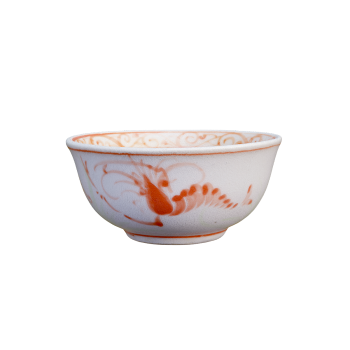
Japanese Red crowned Crane Black Ceramic Bottle (left) - Krakow Japan Art and Technology Center, Poland

The Japanese Art and Technology Center, located in Krakow, Poland, is renowned for its exquisite craftsmanship and traditional themes, showcasing the level of Japanese craftsmanship during the Meiji period (1868-1912). Adopting cloisonn é enamel technology, silver wire is used to outline the pattern of flying cranes flying on a dark blue background, and the white crane body is embellished with gray and red elements, presenting a continuous style. At the edge of the bottle mouth and near the base, a red circular pattern border can be seen. Under the base, you can see the symbol of the "ヨ" syllable in a form similar to Japanese katakana. He is a representative of Japanese culture and craftsmanship.
BENIHANA Teppanyaki Restaurant in Tokyo, Japan - Teacup
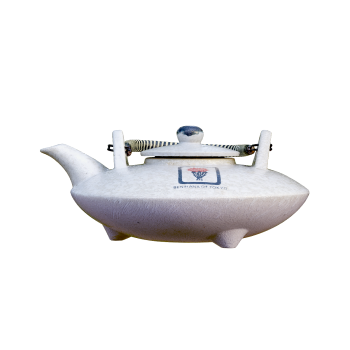
BENIHANA Teppanyaki Restaurant in Tokyo, Japan - Teacup

It is a Japanese teppanyaki restaurant that originated in New York in 1964, founded by Hiroaki Aoki. Its name means "red flower" in Japanese. The restaurant is renowned for its unique performance style cooking and interactive experience, where chefs cook live in front of customers, providing them with a dramatic and visually enjoyable dining experience. The interior decoration of the restaurant is mainly in red and black, creating a warm and vibrant atmosphere. The restaurant offers a menu that includes various meats, seafood, and vegetables, and chefs will cook according to customers' preferences. It is also a cultural experience venue that attracts many tourists and food enthusiasts.
BENIHANA Teppanyaki Restaurant in Tokyo, Japan - Teapot

BENIHANA Teppanyaki Restaurant in Tokyo, Japan - Teapot

It is a Japanese teppanyaki restaurant that originated in New York in 1964, founded by Hiroaki Aoki. Its name means "red flower" in Japanese. The restaurant is renowned for its unique performance style cooking and interactive experience, where chefs cook live in front of customers, providing them with a dramatic and visually enjoyable dining experience. The interior decoration of the restaurant is mainly in red and black, creating a warm and vibrant atmosphere. The restaurant offers a menu that includes various meats, seafood, and vegetables, and chefs will cook according to customers' preferences. It is also a cultural experience venue that attracts many tourists and food enthusiasts.
Japanese ceramic tray

Japanese ceramic tray

Chinese white glazed porcelain vase with colored cracks

Chinese white glazed porcelain vase with colored cracks

It is a molded porcelain drum shaped Chinese porcelain vase with white glaze and colored cracks. The production period is from 1950 to 1960. White glaze and cracked glaze effects are common techniques in porcelain production. White glaze provides a smooth and reflective surface, while cracked glaze is a special decorative technique that creates unique textures and patterns by introducing tiny cracks into the glaze. Not only is it beautiful, but over time, porcelain with cracked glaze will gradually develop its own unique appearance. It is part of the William M. Lindgren Asian Art Collection, preserved in the archives of St. Cloud State University.
Glass enamel decorated Chinese cloisonn é vase

Glass enamel decorated Chinese cloisonn é vase

It is a Chinese cloisonn é vase decorated with glass enamel, belonging to the William M. Lindgren Asian Art Collection and currently housed in the archives of St. Cloud State University. The period is approximately between 1930 and 1950. Cloisonn é craftsmanship is an ancient Chinese metal craft known for its exquisite copper body, enamel glaze, and complex production process. This process usually involves welding fine copper wires onto a copper body to form patterns, then filling these patterns with enamel glaze. After multiple firing and polishing processes, the final product is a colorful and glossy artwork. It is one of China's intangible cultural heritages.
Maya Culture Ceramic Wine Cup - Metropolitan Museum of Art

Maya Culture Ceramic Wine Cup - Metropolitan Museum of Art

This cylindrical drinking cup, which is a Maya cultural artwork collected by the Metropolitan Museum of Art, is considered a representative work of the Maya pottery painter "Metropolitan Master". It features a mythological scene depicting the young rain god Chahk and a supernatural young leopard. Chahk appears in its typical attire and symbolic accessories, while juvenile jaguars are presented with their supernatural facial features and body details. Not only does it showcase the exquisite craftsmanship of Maya art, but it also reflects the complex myths about life, death, and rebirth in Maya culture. Provided important clues for researchers on Maya religion and ritual practices
Clay Vase - Krakow Archaeological Museum, Poland

Clay Vase - Krakow Archaeological Museum, Poland

The Archaeological Museum in Krakow, Poland, has a collection of pottery fragments dating back to ancient times. These fragments were discovered during salvage excavations at the 1c site in Mogila (the area where the S. Ż eromski Hospital is located) in 1958. After repair, this pottery was able to be restored. It is made of sieved good soil on a ceramic wheel, with a smooth surface and polished. Above the crease on the shoulder, a decoration can be seen, limited by decorative strips, presented in a zigzag and diagonal mesh shape, separated by three buttons. This decoration is similar to the common decoration in the Przewalski culture and also appears on the edge of this container.
Dog shaped ceramic container

Dog shaped ceramic container

From the central coast of present-day Peru. It represents a dog breed called "viringo", which is the Peruvian Hairless Dog. In ancient American culture, it was valued for its unique appearance and characteristics, and was included in funeral ceremonies, as well as depicted on painted pottery. Nowadays, it has become an important symbol of Peruvian culture. It showcases the ancient Peruvian people's worship and artistic expression of animals, reflecting their profound understanding and respect for nature and animals. Be able to understand the lifestyle, religious beliefs, and artistic aesthetics of ancient Peruvian society. It is one of the important physical evidence for studying ancient Peruvian civilization.
Chancay culture monkey shaped pottery container

Chancay culture monkey shaped pottery container

It is a ceramic artwork in the Chancay culture, created around 1300 to 1500 by an unknown Peruvian artist. Usually used for storing water, which is crucial for survival in the dry desert climate where one resides. The Chancay culture is located in the central coastal region of Peru, where the climate is hot and dry, but there are some oases connected to distant areas of the Andes mountain range, allowing for communication with other cultures and communities, trading plants, food, and other agricultural products. On both sides of the neck are a pair of monkeys, both covering their mouths with their hands. The monkey's tail curves upwards and connects to the neck of the container.
Ancient snake shaped ceramic container

Ancient snake shaped ceramic container

Chinese Porcelain Salt Bottles - Krakow Salt Museum

Chinese Porcelain Salt Bottles - Krakow Salt Museum

It is a Chinese porcelain item collected in the Krakow Salt Museum. It is a representative of early white blue porcelain, decorated with cobalt blue, and is a rare form of Far Eastern porcelain imported to Europe. Created during the Kangxi reign of China (1662-1722), it is an outstanding representative of ancient Chinese porcelain art. The porcelain of the Kangxi period is famous for its exquisite craftsmanship and unique aesthetics. This porcelain not only showcases the traditional craftsmanship of Chinese porcelain, but also reflects the cultural exchange and trade between China and Europe at that time.
Japanese Peony Ceramic Container - Cleveland Museum of Art

Japanese Peony Ceramic Container - Cleveland Museum of Art

It is a porcelain piece created by Seif ū Yohei III (Japan, 1851-1914), approximately made in 1914. Green glaze was used, and molding and carving techniques were employed in the design. This porcelain is collected by the Cleveland Museum of Art and was a gift donated by James and Christine Heusinger. It showcases the exquisite craftsmanship and aesthetic characteristics of Japanese porcelain art. Not only is it a practical water container, but it is also an exquisite artwork. The peony pattern on it symbolizes wealth and prosperity, reflecting the pursuit of beauty and appreciation of natural beauty in Eastern culture
Spanish ceramic kettle

Spanish ceramic kettle

15th century medieval semi glazed clay wine pot - Hunter Museum in Limerick

15th century medieval semi glazed clay wine pot - Hunter Museum in Limerick

It is a precious ceramic artwork. It has a ribbon shaped handle, with glazed covers on the upper part, handle, and neck inside and outside. This work is currently housed in the Hunter Museum in Limerick. In the Middle Ages, it was a common daily item with a simple and practical design. The ribbon shaped handle is convenient for carrying and pouring wine, while the glazed surface on the neck may be used to protect the pottery from liquid erosion, while also increasing its aesthetic appeal. Although it has been a long time, this semi glazed wine pot is still well preserved, providing us with valuable information for studying medieval ceramic craftsmanship and daily life.
Maiolica Italian style medicine jar - Hunter Museum in Limerick

Maiolica Italian style medicine jar - Hunter Museum in Limerick

It is a type of painted pottery originating from the Italian Renaissance period, known for its bright colors and exquisite decorations. Its shape is cylindrical at the waist, which makes it easy to carry and store medication. The center front of the medicine jar is decorated with an oval shaped portrait of a man, surrounded by exquisite leaf shaped patterns and carving techniques. These decorations are mainly in blue, yellow, and white, showcasing the unique colors and artistic style of Majorica pottery. Portrait painting emphasizes the personality traits of characters, rather than traditional beauty or handsomeness, reflecting the Renaissance's emphasis on character and inner qualities.
Jerusalem Ceramic Pomegranate

Jerusalem Ceramic Pomegranate

It is a traditional handicraft with Middle Eastern characteristics, originating from ancient Eastern culture, especially in the region centered around Jerusalem. This type of handicraft is usually based on pomegranates and handmade using ceramic materials. The surface is often painted with exquisite patterns and colors, representing the beautiful meaning of prosperity and many children and blessings. Pomegranate is a highly symbolic fruit in Middle Eastern culture, representing not only the continuation of life and the reproduction of families, but also health and longevity. Therefore, ceramic pomegranate has become a popular decoration, often placed in homes and public places to express wishes for a better life.
Musico Moche Civilization Ceramic Container

Musico Moche Civilization Ceramic Container

During the pre Columbian period, music and dance were an indispensable part of the local cultural tradition in the Musico Moche civilization (200-850 AD). Musical instruments made by cultures such as Moche provide rhythm and atmosphere for religious ceremonies and community activities such as farming, channel cleaning, or sowing. This pottery container depicts the image of a Moche musician. He was wearing a long robe decorated with natural element patterns, such as waves, cats, and snakes. Under focused gaze, he was playing the Andean flute or panpipe, playing the melody.
Ancient Twin Body Bottle Ceramic Container

Ancient Twin Body Bottle Ceramic Container

It is a container with a dual body structure, usually having a bridge shaped handle and a straight neck. The front part is sculptural, while the back part is a side pressed spherical shape decorated with goose skin texture and a personified figure wearing a hat, earmuffs, collar, and anku (an ancient Egyptian scepter). The sculpture depicts a female figure sitting on her lap, breastfeeding a baby sitting on her left knee. This woman has long hair and neck decorations.
Alabast bottle

Alabast bottle

It is a small pottery or glass container used to hold oil. Originating from ancient Egypt in the 11th century BC, it was originally a container carved from snowflake plaster, which is also the origin of the name "Alabast Bottle". Over time, this type of container began to be made using more materials besides snowflake gypsum. Most Alabast bottles have a similar shape, with a slender body and a circular bottom. Usually there is an opening with a lip at the top, and there may be small handles on both sides of the container neck.